
Against Consistency
Bringing chaos upon scientific enquiry


In Guyana, South America, scientists led by a political incentive sought to discover and clone the ancient Pokémon Mew. The scientific community at the time generally considered Mew to be extinct, making the prospect of cloning it highly controversial. One of the leading scientists, Dr. Fuji, had intentions of his own. He wished to clone his deceased daughter, Amber.1
Having found an eyelash of Mew, through horrific gene splicing and DNA engineering experiments, the world’s most powerful Pokémon was created. This process was far from parsimonious, and standard cloning (genome replication) was abandoned in favor of transgenic modification. Since Mew is small (0.4m), Mewtwo (Mew’s genetically modified clone) was engineered to be massive (4.0m) with a more humanoid, muscular physiology. Traits like empathy and compassion were seen as hindrances to combat efficiency, and so, were edited out of Mewtwo’s genome. “Despite these efforts, Mewtwo initially lacked any sense of ‘consciousness’. This led to a desperate, and ultimately fatal, trial-and-error approach where Mewtwo’s psychological stability was sacrificed for physical power, leading to the destruction of the lab when Mewtwo finally became self-aware”.2
There are very visible methodological similarities between Mewtwo’s creation and the scientific revolutions of today. Revolutions establish new methodological criteria, tear apart old rules of rationality, and contradict the well established data. What we may learn from this is that it is not only our best scientific theories that may need discarding, but perhaps, all universal rules of rationality along with it. This essay is concerned not with proving scientific realism to be false, but rather, with disproving a specific, commonly accepted rule. Thus, even scientific realists must find themselves sympathetic to a rejection of the rule that is the consistency condition.
The consistency condition, stated explicitly, is the thesis that (1) New hypotheses should align with, or at least account for, current facts and established knowledge, & (2) New hypotheses should not contradict well established experimental results. In rejecting this view, I advocate for an anarchistic epistemology, by which what we call ‘rules of rationality’ are fixed case by case, model by model.
By my lights, Giovanni3 is not much different from Galileo, for they were both brilliant and manipulative propagandists that ensured the success of their view by any means possible. It is then, as Galileo and Feyerabend say; we must progress not by adhering to strict rationalistic rules, but by forming rules of our own, moving forward counter-inductively.
“The invention of atomism in antiquity, the Copernican revolution, the rise of modern atomism (kinetic theory; dispersion theory; stereochemistry; quantum theory), the gradual emergence of the wave theory of light, occurred only because some thinkers either decided to not be bounded by certain ‘obvious’ methodological rules, or because they unwittingly broke them” (Feyerabend 1975).
Against Fact/Theory
If we wish to show the consistency condition false, we must begin by untangling some leftover weeds in the philosophy of science. The first weed being the distinction between what may be considered ‘fact’ and ‘theory’. We must evolve into philosophers of science who find themselves sympathetic to the theory-ladenness of observation. In doing so, we preempt an objection raised against historical cases in which theory has been overturned, yet observational data remain ‘supposedly’ uncontradicted. For example, a naive defender of fact/theory may think that the observations cited as counterexamples to heliocentrism, such as birds in flight not being disrupted by the Earth’s purported movement, or the lack of stellar parallax, merely turned out to require revisions to theoretical interpretations of the data, but not the data itself. By thinking of data as inseparable from theory, a rejection of an alternate theory will be a rejection of the given facts in its domain. No theory agrees with all the facts in its domain, but this is not the theory’s fault. Facts are remnants of older theories and observational languages; a clash between fact and theory may be proof of progress.4
ACT 1: Arthur Worthington’s Symmetrical Milk Drops
In 1875, physicist Arthur Worthington documented symmetrical patterns of droplet splashes using splash illumination, carefully tracking the drop dynamics with a strobe light to burn a sequence of images into his retinas. Worthington observed and hand-drew perfectly symmetrical, orderly “coronets” with evenly spaced jets. For nearly twenty years, Worthington both believed and taught that splashes were mathematically precise symmetrical events.
When Worthington got his hands on high-speed photography to capture the same events, his results were drastically different. The photographs revealed that the splashes were messy, irregular, and asymmetrical. As a result, Worthington coined the term “auto splash”, which refers to how the existence of symmetrical splashes was idealized and constructed by him. It is likely that it is Worthington’s own desire for perfection that drove his brain to fill in the blanks to complete the image in this manner.
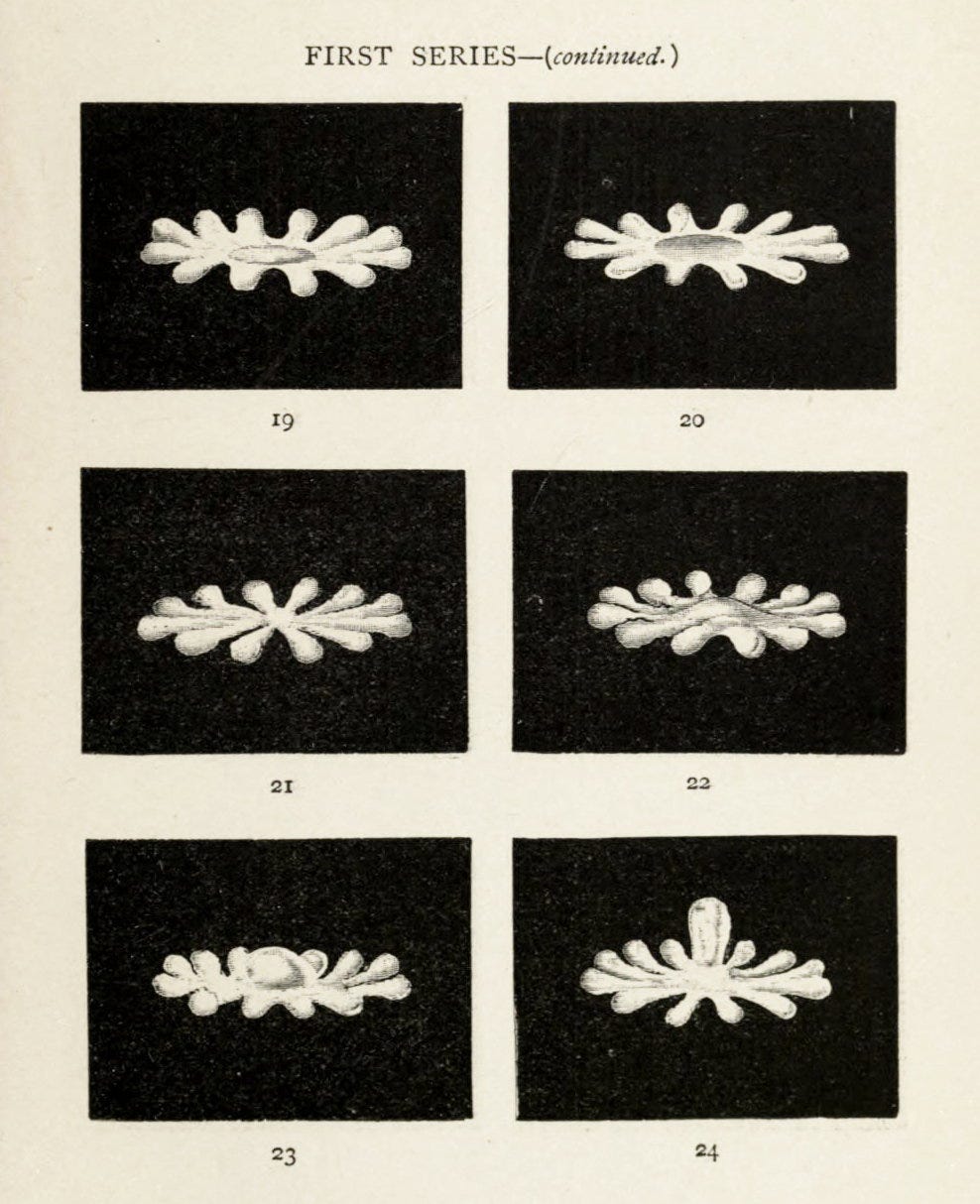
From this, the SEP states, “if theoretical commitments, like Worthington’s initial commitment to the perfect symmetry of the physics he was studying, pervasively and incorrigibly dictated the results of empirical inquiry, then the epistemic aims of science would be seriously undermined”5
Worthington’s case by itself is not enough for us to erase the fictive distinction between fact and theory, for we may find ourselves saying that although observation may be theory-laden, scientific instruments grant us theory-independent access into reality. Perhaps we contend that there remains such thing as a ‘view from nowhere’. While I am fine to grant that our instruments are not distortion machines in Giere’s sense of the term ‘distort’.6 In ACT 4, I defend the view that scientific instruments are theory-laden. Before I do so, I must put fuel to the fire that burns fact and theory.
ACT 2: Tycho & Kepler
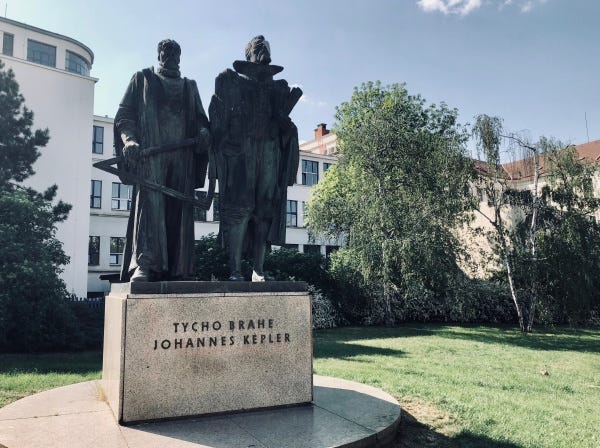
“Let us consider Johannes Kepler: imagine him on a hill watching the dawn. With him is Tycho Brahe. Kepler regarded the sun as fixed: it was the earth that moved. But Tycho followed Ptolemy and Aristotle in this much at least: the earth was fixed and all other celestial bodies moved around it. Do Kepler and Tycho see the same thing in the east at dawn?”
N.R. Hanson continues,
”Seeing is an experience. A retinal reaction is only a physical state-a photochemical excitation. Physiologists have not always appreciated the differences between experiences and physical states. People, not their eyes, see. Cameras, and eye-balls, are blind. That Kepler and Tycho do, or do not, see the same thing cannot be supported by reference to the physical states of their retinas, optic nerves or visual cortices : there is more to seeing than meets the eyeball” (Hanson 6).7
While their visual input is identical, Hanson and I defend the view that Tycho sees the sun moving up over a stationary horizon, whereas Kepler sees a stationary sun being revealed by the rotation of the earth. If we wish to be good scientists, we must reject the view that seeing is merely physical state, and cast doubt on the view that Tycho and Kepler are seeing the same thing, but with different interpretations.
Let us consider reversible perspective figures in gestalt psychology. In these cases, different things are seen in the same configuration, when which there is no ‘interpretation’ superimposed by sensation (Hanson 19).
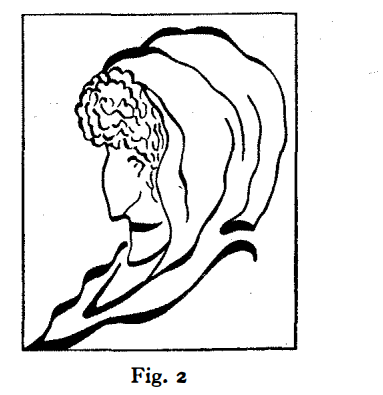
As Hanson says, there is an obvious sense in which one who cannot see the young lady in Fig. 2 is seeing something different from me, who sees the young lady.
ACT 3: Duck Rabbit
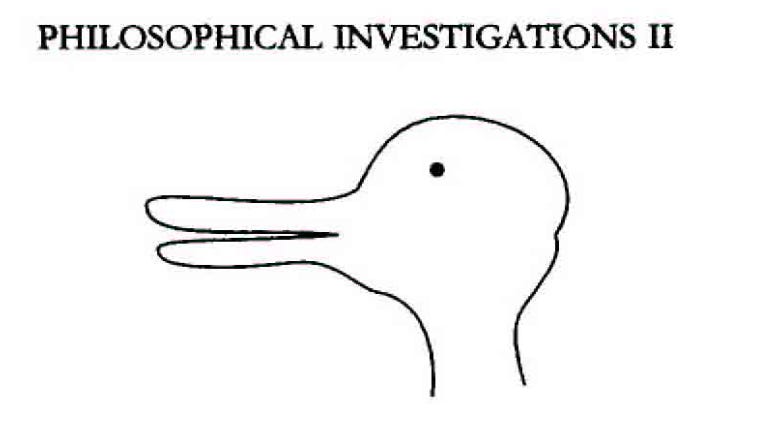
Perhaps you see a duck, or maybe you see a rabbit. Maybe you can only see it as one and not the other. Interpretation aside, the infamous duck-rabbit image bears a striking resemblance to the image we have just discussed. To understand Hanson’s argument, we need to understand Wittgenstein’s use of the term ‘seeing-as’. He writes,
“I contemplate a face, and then suddenly notice its likeness to another. I see that it has not changed; and yet I see it differently. I call this experience “noticing an aspect…” And I must distinguish between the ‘continuous seeing’ of an aspect and the ‘dawning’ of an aspect… I see two pictures, with the duck-rabbit surrounded by rabbits in one, by ducks in the other. I do not notice that they are the same” (Wittgenstein 1953).
'“noticing an aspect” and the ‘dawning’ of an aspect are both instances of seeing-as—conceptually structured perception. One may pair ‘seeing-as’ with ‘seeing-that’, in which seeing-as is parasitic on seeing-that (Rosenhagen 2019). On this view, seeing-that refers to a propositional articulation of conceptual experience. Because Hanson takes it that all epistemically significant seeings must involve concepts, he argues that seeing x as F requires inhabiting a network of beliefs about Fs, which are then articulated through seeing-that. On Rosenhagen’s interpretation of Hanson, he writes,
”To be epistemically significant, Hanson claims, seeings must be able to bear on our beliefs. Not all seeings are. Peekings through microscopes and starings through windows of moving trains are seeings. But one may be ignorant of what one sees, or stare mindlessly. When Hanson contends that such seeings lack epistemic import, his point is broadly Kantian. Without concepts, Kant famously claims, intuitions are blind (Kant 1968, B 75). Hanson, too, holds that seeings that are exhausted by one’s being visually struck remain kaleidoscopic. To intelligibly bear on our beliefs, the purely visual aspect of seeing must be brought under concepts. Here is how Hanson thinks this works: as we observe the items we face, we see them as things of certain kinds, as having certain properties, and as behaving in certain ways. Epistemically significant seeing, he suggests, must involve seeing as” (Rosenhagen 4).
The Kantian claim about perception is correct, for it has been shown that our theories and interpretations are not prior to perception, they are there from the outset. This then, is Hanson’s link between seeing-as and seeing-that. As Rosenhagen notes, the intelligibility of concepts operative in seeing-as is partly spelled out in terms of (at least implicit commitments to) subjunctive claims. And, as Brandom says, Hanson is to be put in the same camp as Kant and Sellars, each holding that our use of predicates already presupposes an implicit grasp of the kinds of properties and relations made explicit by modal vocabulary (Brandom 2008).
If seeing-as is parasitic on seeing-that and all epistemically significant-seeing is to be understood through seeing-as, then we must ask ourselves, are scientific instruments an epistemically significant seeing? Under Hanson’s view, seeing is an experience, and so, it seems as though scientific instruments in themselves cannot see (obviously). Perhaps we can try and solve this problem by saying that scientific instruments act as extensions of human perception. The worry here, is that we have put ourselves in a checkmate. Perception is itself theory-laden, so an extension of one’s visual field definitely does not escape this worry.
ACT 4: Delia & Verity
Delia and Verity are two microbiologists, each is tasked with observing a Protozoon—Amoeba. One sees a single-celled animal, the other a non-celled animal. “Delia sees Amoeba in all its analogies with different types of single cells: liver cells, nerve cells, epithelium cells. These have a wall, nucleus;, cytoplasm, etc. Within this class Amoeba is distinguished only by its independence. Verity, however, sees Amoeba's homology not with single cells, but with whole animals. Like all animals Amoeba ingests its food, digests and assimilates it. It excretes, reproduces and is mobile-more like a complete animal than an individual tissue cell. This is not an experimental issue, yet it can affect experiment. What either woman regards as significant questions or relevant data can be determined by whether she stresses the first or the last term in 'unicellular animal” (Hanson 4).
Although Delia & Verity share quite obvious similarities with Tycho and Kepler, the former are using scientific instruments! Having already established that Tycho & Kepler see different things, why should we expect any different under our beloved microbiologists?
The classic realist view that scientific instruments work as extended perception is futile against objections to fact/theory. If we wanted to take an alternative view, we might say that instruments are causal interfaces (Hacking 1983). Or perhaps, taking objections to fact/theory into consideration, we may say that instruments physically embody theories. On pain of drifting away from the topic of the essay, I will make this point incredibly brief. Let us remember that for Hanson, a seeing is epistemically significant if and only if it can bear on our beliefs. If this is the case, then Hacking is already in quite a bit of a pickle, for causal interaction is itself theory-laden. The causal chain does not determine the classification of the phenomena, we do. Pace Kane Baker, we should have to draw a line somewhere if we wished to make a distinction. But if we have to draw a line anywhere, then it becomes our distinction, not nature's (Baker 203).8
Schindler is then correct when he says that “P. Feyerabend, in his Against Method, pointed out that Galileo, when gathering telescopic observations in support of the sun-centred universe in the early 17th century, had no knowledge of the working of the telescope. Amongst other things, Feyerabend reasons that Galileo would have needed such a theory to provide good grounds to convince his sceptical contemporaries of the truth of heliocentrism. Pointing the telescope to terrestrial objects in order to demonstrate its magnifying effect would not have sufficed since his contemporaries thought that the physics on earth was completely different from the physics of the heavens. In fact, Feyerabend accuses Galileo of circular reasoning: in order for Galileo’s telescopic observations to be acceptable evidence for his contemporaries, Galileo had to show the inadequacy of the Aristotelian “two-physics” world picture. But in order to show this, he relied on his telescopic observations, which, again, presupposed that the physics on earth and the physics of the heavens were the same” (Schindler 2015).
The Consistency Condition
Having muddied the distinction between fact and theory, we may now turn to the heart of this essay. The consistency condition, restated, is the thesis that (1) New hypotheses should align with, or at least account for, current facts and established knowledge, & (2) New hypotheses should not contradict well established experimental results.
This view has been defended historically by scientists and philosophers of science alike.9 Newton, Kuhn, Duhem & Popper are popular defenders of this view. Seeing that it is incredibly popular, it should have something going for it (right?), so let’s go over what some (confused) philosophers of science have to say. Newton writes,
"We are certainly not to relinquish the evidence of experiments for the sake of dreams and vain fictions of our own devising; nor are we to recede from the analogy of Nature, which uses to be simple, and always consonant to itself." — [Rule III, The Principia, 1726 Edition] [1, 2]
Newton warns us to not let our imagination run free, but why should we accept this? We must look to Thomas S. Kuhn for an argument of this sort.
First Movement - Kuhn & Normal Science
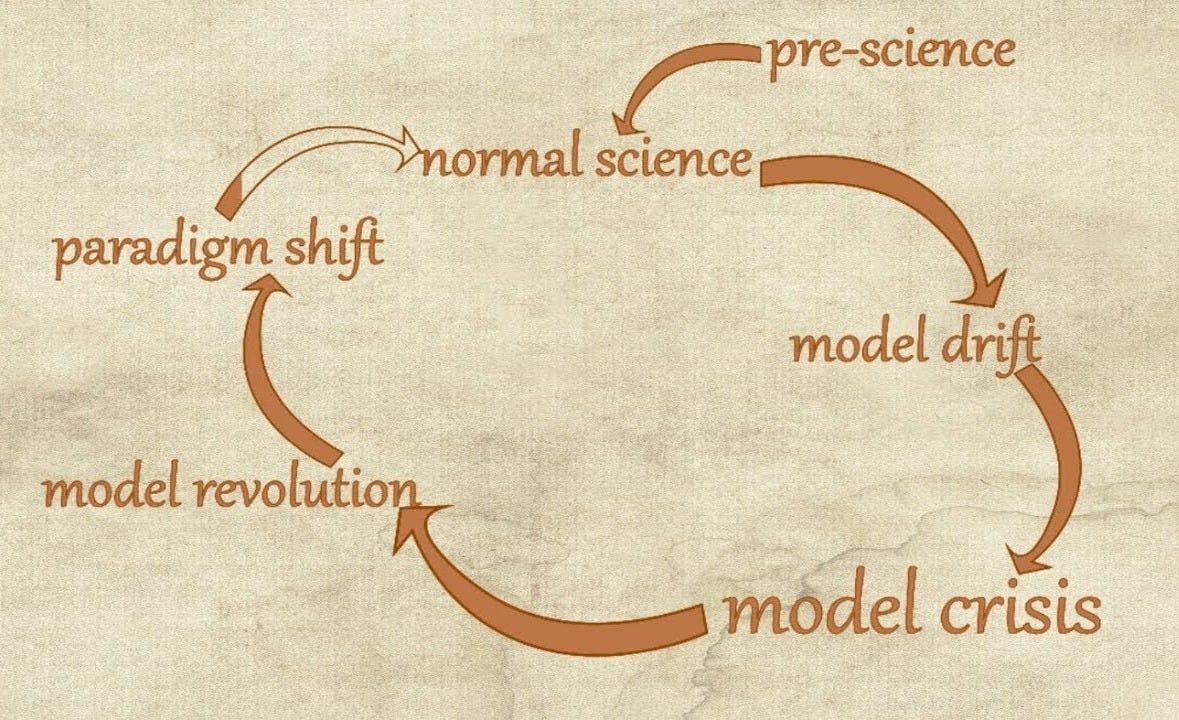
I will begin by briefly laying out Kuhn’s broader theory of scientific progress. Kuhn holds the view that scientific progress occurs within a given paradigm until mounting anomalies force a paradigm shift, which is otherwise known as a scientific revolution. For Kuhn, ‘paradigm’ refers to a shared ontology or worldview, whereas ‘anomalies’ are observations that violate the paradigm-induced expectations that govern normal science. Normal science, for Kuhn, is characterized by the dominance of a given paradigm, but are interrupted by occasional revolutions, in which the old paradigm is replaced with a new one (Schindler 2). Kuhn describes normal science (a supposedly shared, unquestioned paradigm within which scientists collectively perform inquiry) as follows,
”When examining normal science […] we shall want finally to describe that research as a strenuous and devoted attempt to force nature into the conceptual boxes supplied by professional education”. The “conceptual boxes” are those given by the dominant paradigm. Sometimes observations and experiments appear to contradict the paradigm, but normal scientists do not react by questioning the validity of the paradigm. They see the situation as a puzzle which has to be resolved while maintaining the paradigm. Hence, their activity is described by Kuhn as “puzzle-solving”. He gives the following further description of normal science: “Normal science, the activity in which most scientists inevitably spend almost all their time, is predicated on the assumption that the scientific community knows what the world is like. Much of the success of the enterprise derives from the community’s willingness to defend that assumption, if necessary at considerable cost” (Kuhn 1962).
Honestly, I am unsure if Kuhn is presenting a methodological prescription as to how science should proceed, or a description regarding activities which he classifies as ‘scientific’. Absent any concern of demarcation between science and pseudo-science,10 for the sake of simplicity, we will take it that Kuhn is making a prescriptive claim, particularly a defense of the consistency condition. On this reading I take Kuhn to be saying that new, revolutionary hypotheses that contradict the current paradigm ought to be restricted during normal science’s first stages. From this, it follows that the consistency condition ought only be broken in periods of crisis, in which anomalies accumulate and a paradigm shift is near.
Before I lay out the motivations for Kuhn’s view, I must clarify what is meant exactly by the use of the word ‘consistency’. As Feyerabend mentions, it is well known that Newtonian mechanics is inconsistent with Galileo’s law of free fall and with Kepler’s laws, that wave optics is inconsistent with geometrical optics; and so on. Note that what is being asserted here is logical inconsistency. Note also that what is being asserted isn’t the inconsistency of Newton’s theory and Galileo’s law, rather, the inconsistency of some consequences of Newton’s theory in the domain of validity of Galileo’s law, and Galileo’s law (Feyerabend 1975). The consistency condition does not do this, it eliminates a theory not because it disagrees with the facts, but merely because it disagrees with another theory. For Kuhn, the consistency condition may only be violated when anomalies to our current theory have begun to emerge. I must say, this seems incredibly counter-intuitive. Would we not speed up the process, acquiring anomalies at a faster pace by proceeding counter-inductively?
In this sense, the consistency condition contributes to the preservation of the old and familiar theory not because of any inherent advantage, but merely because it is old and familiar. Are we to say now, that old-ness and familiarity are natural kinds? That they are theoretical virtues? For oldness and familiarity do not carry the same rhetorical weight as simplicity and parsimony do. Where defenders of simplicity can appeal to historical examples in its favor, defenders of the consistency condition cannot.
A defender of consistency may say, in response to these charges, that the constant replacement of current paradigms will be no easy matter. That textbooks must be constantly rewritten, university curricula constantly readjusted. Perhaps they are adamant, leading them to stomp their feet and ask what the use is of another theory which from an empirical standpoint has no advantage whatsoever over and above the theory it replaces (Feyerabend 19). Defenders of consistency take violations of the consistency to be hinderances to progress, suggesting that they promote fruitless discussion, absorbing important time and manpower that could otherwise be dedicated to normal science. On this view, the only pressing reason for theory change is disagreement with facts, pace Kuhn’s anomalies. It is thus a hinderance to progress for one to increase the number of factually adequate, incompatible alternatives, as opposed to increasing the number of relevant facts.
Second Movement - Inconsistent Alternatives
What is being called into question is the autonomy principle, which Feyerabend states as follows,
”And so it is - provided facts exist, and are available independently of whether or not one considers alternatives to the theory to be tested. This assumption, on which the validity of the foregoing argument depends in a most decisive manner, I shall call the assumption of the relative autonomy of facts, or the autonomy principle. It is asserted that the facts which belong to the empirical content of some theory are available whether or not one considers alternatives to this theory” (Feyerabend 20).
As we have shown earlier, fact and theory share a far more intimate relationship than is often thought. Although the degree of this relationship may be called into question, what we have established is that there is no firm boundary between fact and theory, that our observation is relative to our background theory. If the relationship between fact and theory are intimate in this regard, it follows that there exists facts which cannot be unearthed except with the help of alternatives to the theory to be tested, which becomes unavailable once alternatives are excluded. Take T1 and T2, assume that both are empirically isomorphic. If the facts in T1 and the facts in T2 exist relative to the theoretical apparatus, it seems as though a clash between T1 and T2 may reveal facts which are to be unearthed by a new theory T3. Alternatives, then, are crucial for a scientist who wishes to proliferate the facts. Thus, defenders of the consistency condition put the cart before the horse, for they maintain that the only case in which an alternative theory ought to be proposed is when anomalies emerge. Why on earth would we wish to prevent the emergence of anomalies?
The scientist and/or empiricist who wishes to maximize the empirical content of their knowledge ought to reject the consistency condition for this very reason. That being said, let us now turn to historical examples in alternatives served crucial to the discovery of new facts.
Third Movement - Brownian Motion
It was mentioned earlier that Newtonian mechanics was incompatible with Galileo’s free fall. In similar manner, Feyerabend writes, "it is now known that the Brownian particle is a perpetual motion machine of the second kind and that its existence refutes the phenomenological second law. Brownian motion therefore belongs to the domain of relevant facts for the law”. He asks us, “Now could this relation between Brownian motion and the law have been discovered in a direct manner, i.e. could it have been discovered by an examination of the observational consequences of the phenomenological theory that did not make use of an alternative theory of heat?” We can frame this question as a dilemma:
(1) Could the relevance of the Brownian particle have been discovered in this manner?
(2) Could it have been demonstrated that it actually refutes the second law
The answer to (1) is that there is no fact of the matter about this counterfactual, that we simply do not know. Had kinetic theory not been introduced into the debate, it is plausible that the Brownian particle would be rejected as an oddity, but this is merely an intuition of mine. The second law was considered inviolable within that framework, and it is likely that such an anomaly would be viewed as an outlier.
The answer to (2) is clearly and plainly—No. To quote Feyerabend once more, “Consider what the discovery of an inconsistency between the phenomenon of Brownian motion and the second law would have required: (a) measurement of the exact motion of the particle in order to ascertain the change in its kinetic energy plus the energy spent on overcoming the resistance of the fluid; and (b) precise measurements of temperature and heat transfer in the surrounding medium in order to establish that any loss occurring there was indeed compensated by the increase in the energy of the moving particle and the work done against the fluid. Such measurements are beyond experimental possibilities; neither the heat transfer nor the path of the particle can be measured with the desired precision. Hence a direct refutation of the second law that considers only the phenomenological theory and the ‘facts’ of the Brownian motion is impossible.” He continues, “The actual refutation was brought about in a very different manner. It was brought about via the kinetic theory and Einstein’s utilization of it in his calculation of the statistical properties of theory (T’) was incorporated into the wider context of statistical physics (T) in such a manner that the consistency condition was violated, and it was only then that crucial experiments were staged (investigations of Svedberg and Perrin)” (Feyerabend 21).
Within phenomenological thermodynamics, since the laws are considered universal constraints, there are no mechanism inside the theory for a visible exception to be found. An exception is only visible once we step outside the theory, which in this case, is kinetic theory. Let us recall my central argument, that a clash between empirically isomorphic theories, T1 and T2 may reveal facts which are to be unearthed by a new theory T3. In this case, let T1 be phenomenological thermodynamics, T2 be kinetic theory, and T3 be modern statistical mechanics.11 By which we know that prior to kinetic theory providing the conceptual apparatus to make true the proposition “Brownian motion refutes the second law”, all we knew was the proposition, “Brownian particles move erratically”. The epistemic status of Brownian motion as a counter-example arose because of the function of an alternative theory.
Last Movement - Return To Mewtwo
Having rid ourselves of the very troublesome fact/theory distinction, we may grow into pluralistic scientists, who have humanity’s best interests in mind. There is, however one crucial question which remains unanswered, that being, would Giovanni have achieved his goals had he accepted the consistency condition as true?

The answer to this is a simple and straightforward—No. That Mewtwo’s creation was only made possible by violating the consistency condition is so obviously true that any and all defenders of the consistency condition are likely still mourning the death of Dr. Fuji. The pursuit of Mew despite no empirical evidence in favor of its existence, the abandonment of standard cloning in place of genome replication, the use of horrific DNA engineering led to Mewtwo’s creation not only because Giovanni chose not to be bound by strict, rationalistic rules, but primarily because he willingly broke them.
The original 1998 Pokémon: The First Movie is my source material for this essay. I am aware that in context of games, the lore differs.
This is taken from the following reddit thread: https://www.reddit.com/r/pokemonanime/comments/ztovu8/why_dr_fuju_and_by_extension_mewtwos_origin_is/
Giovanni is the one who funded this research program. He approached Dr. Fuji and asked to fund his research into cloning in exchange for a powerful Pokémon. In this sense, Giovanni took advantage of Dr Fuji’s desire to revive his deceased daughter.
Quote From Against Method
This is from the SEP on ‘theory and observation’', for more see: https://plato.stanford.edu/entries/science-theory-observation/#TheValLad
Ronald Giere sees distortion as a fundamental characteristic as to how scientific instruments operate. There is good reason to think that this is false. For one, Dr. Baker argues in Examining Scientific Perspectivism that “instrumental perspectivism is dependent on a perspectivist account of theories and models (“theoretical perspectivism”) in a way that robs it of philosophical significance”.
https://gwern.net/doc/philosophy/epistemology/1958-hanson-patternsofdiscovery.pdf
This point is short, perhaps a little too short. I was honestly quite afraid that I would drift away from the focus of the essay too much if I honed in on why Hacking’s account of instruments fail. I think Hacking’s account fails to ‘carve nature at its joints’ because I’m a relativist. Since it’d take its own essay for me to make the case for relativism, I decided not to go in depth here. Another thing is that it doesn’t affect the thesis of this essay, if relativism is false. The consistency condition is favorable for the realist as well—even if the realist does not accept my account of theory-ladenness in full, they may accept it partially.
While it is true that Newton and some scientists do take the consistency condition seriously, I think that they have all violated it at least once. For example, the relationship between Newtonian physics and laws of Galileo and Kepler is mathematically inconsistent. For a defense of this, see - Feyerabend 1962
For those who are interested in my views on this topic, I take the view that there is no demarcation between science and pseudo-science. I take the unpopular, although Feyerabendian view that there is no myth, legend, or religious superstition that ought be thrown away as a possible aid to scientific progress.
Strictly speaking, these two are not empirically isomorphic. The broader point is that both theories were incompatible with much of the same empirical domain.
Really enjoyed this piece. Consistency is most likely a good first orientation but it should not be taken as an epistemological criteria which allows one to discard attempts which run counter to the status quo. In regards to the consistency condition I had one thought a while ago which I do not know if it holds under scrutiny:
the consistency condition should be treated as a communicative-social factor of enabling and increasing the efficiency of teamwork. It is an empirical matter I do not have data for, so this can’t be any more than a hypothesis which is open for criticism. Maybe a good metaphor is github repositories. In general you are not restricted to code in your own style, but as soon as you incorporate multiple people, consistency in style can yield efficiency in understanding and productivity in extension. All forks of a project are extensions of one project and some problems might be solved better in restructing the base of the project while it is at the same time not feasible to do so, because many more people are working on and with the same project, referencing the files you think would be better of refactored. One positive point for the consistency condition could be that multiple people can work on the same project, by the same terms and conventions, with the same instruments and the same language, while of course not constructing any epistemological inherent superiority because it is consistent. If I allow myself to extend this to scientific inquiry (which is surely debatable), the extension of theories to be able to account for anomalies might be socially more efficient, because it allows to use the same instruments, the same formulars, the same conventions etc. Consistency in that way is only a social factor and anomalies are sometimes accounted for better by throwing the whole current thing away.
One thought I too come back to quite often is the idea of theory-ladenness of observation. What troubles me a little bit with this metaphor is that concepts are thought of as some kind of perceptual organizing-instrument. I think that the talk of “seeing-as” and “seeing-that” is something we should discard. Theory-ladenness of observation could be reduced to the claim that the extension of a theory towards non-linguistic entities is an illusion and while we have no way of stepping outside, we can’t point to the invariant neutral. The data cannot be extracted and isolated from symbolic practices and therefore what a datum is, is exactly what it is because of its relationship to the symbolic context.
Observation is a difficult term here and we might fall into metaphorical reification if we are not cautious. Let me be plain what I think the only sensible thing of the idea of observational sentences is: certain non-linguistic episodes cause (in a non-determinstic way – because what somebody thinks is not reducible to the causal description of neurophysiological interaction. I think Quine is right in stating that translation is ontologically underdetrmined. I think we can broaden that a little bit without commiting a fallacy to saying that the world does not universally and unequivocally determine what one believes.) linguistic episodes and we have nothing further to ground our beliefs in.
The erasure of the theory-fact distinction does not imply that observation (or experience? How far does it extend its fingers?) is a process in which concepts interact or even construct perception. There remains something I’m uneasy about: we must claim that concepts are wilfully and consciously constructed by scientists in order to claim that the liberation from the consistency condition allows more diverse and effective inquiry by means of becoming anarchistic and pluralistic. Because if we take this to mean aligning with unconscious and unaccessable structures, how much plurality and epistemic advantage is really gained by throwing consistency in the trashcan? At the same time if we grant this wilfull construction, it obviously does not hold for all-day cases. If it rains right now, then it would be better for me to believe that it doesn’t, because my umbrella is at home and not with me. But my belief does not have causal efficacy in relationship to my experience. I’ll get wet, regardless of what I believe. At the same time I’m equally troubled by reinviting some kind of realistic counter pole against which our concepts are measured – that I can somehow determine the truth or falsity of my belief by comparing it with the actual state of the world.
The alternative would be to see our situation as a kind of triangulative situation in which we have to deal simultaneously with other people and the world. The world as a non-propositional cause causes beliefs and those beliefs are not uniquely determined by the non-propositional cause, but depend on the holistic network of symbols one employs in dealing with others. We lose some woowoo magic around living in different worlds by interpreting it in that way. Seen that way, we can neither say that Kepler and Tycho do actually see different things, nor can we sensibly say that they actually see the same thing. Seeing is not touched by concepts. Tycho and Kepler engage in different discourses which might not be collapsed into either, as the rules of Chess cannot be translated into the rules of Checkers without loss. Yet you get wet if you forgot your umbrella, regardless of description.
Worthington's milk drops stopped me.
He didn't draw what the camera captured. He drew what he was prepared to see.
Yogacara Buddhism has a word for this: alaya-vijnana, the "storehouse consciousness." Every prior experience leaves an imprint (bija, Sanskrit for "seed") that shapes what the next perception produces. The drafter and the fact aren't separate.
Your footnote 10 jumped out too: "no myth, legend, or religious superstition that ought to be thrown away as a possible aid to scientific progress." Nagarjuna, writing in the 2nd century CE, spent most of his career doing exactly what you're describing - applying counter-inductive pressure to the foundationalist assumptions of his own tradition. His Mulamadhyamakakarika is essentially a 500-verse argument that every "fact" we build into a fixed criterion is one we'll eventually have to discard.
The consistency condition fails for the same reason the coronet drawings failed. Both assume the observer stands outside the observation.
Is there a version of anarchistic epistemology where tradition and counter-tradition can mutually correct each other, rather than just the counter-tradition winning?